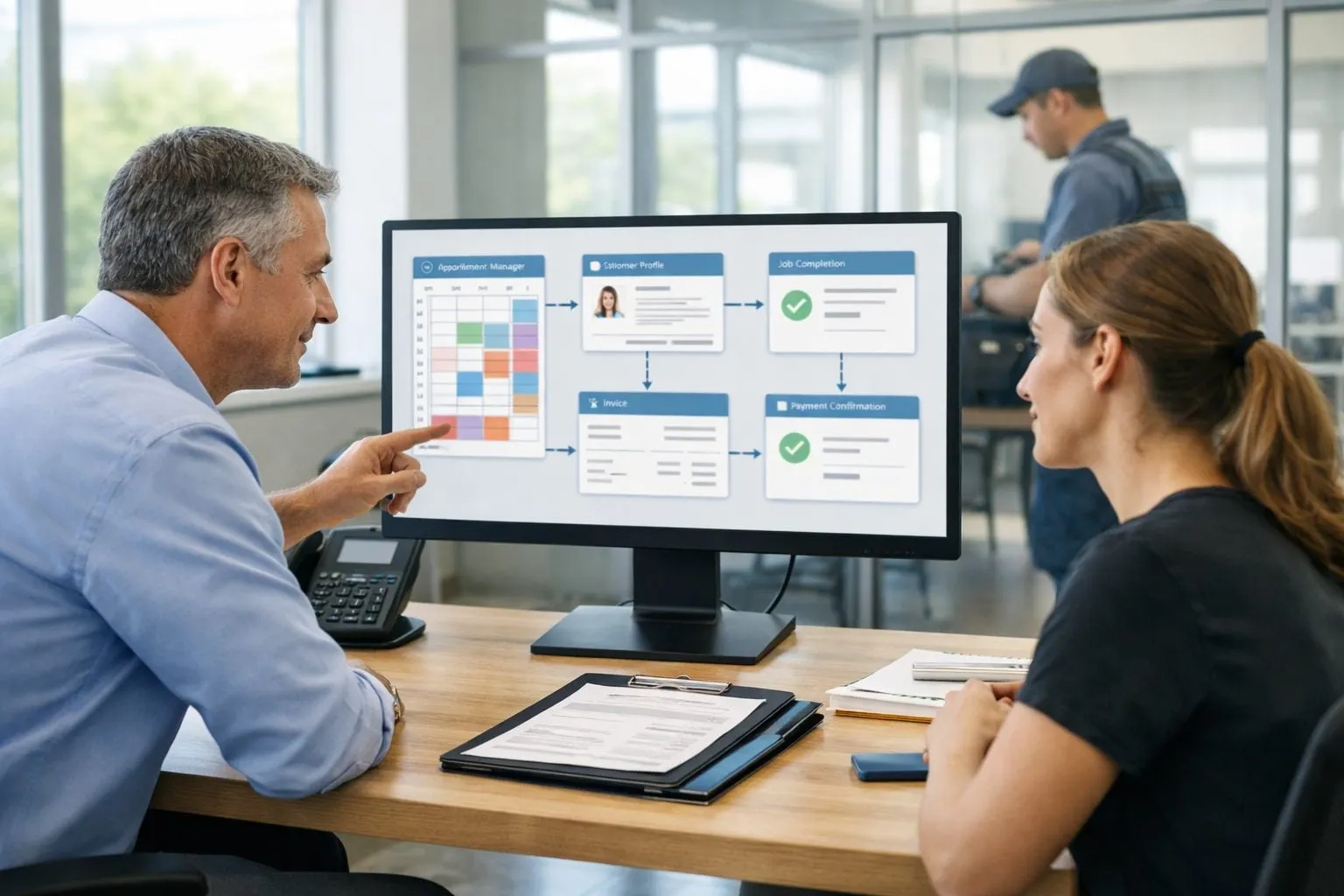
An SMB buyer should treat this as a choice of engagement model, not a ranking of provider quality. In this comparison, an independent automation consultant is engaged to start with an operating problem, such as missed lead follow-up or a dispatch-to-billing handoff, and turn it into a workflow, requirements, and tool-selection plan. A software implementation partner is engaged to apply deep capability in a defined platform or vendor ecosystem. The practical difference is sequence: problem-first work determines the solution path; platform-first work determines how to deploy a chosen system.
That sequence changes scope and accountability. A discovery-led engagement can include process mapping, a recommended architecture, and a build plan across existing tools. A platform-led engagement can focus on configuration, integrations, testing, user rollout, and support for the selected system. Neither label guarantees those responsibilities, so the proposal should name who owns process design, tool choice, implementation, credentials, testing, and post-launch issue resolution.
A useful buying signal is a defined set of deliverables: a workflow map that identifies owners and exceptions, a proposed architecture, a test plan, and support response terms. A vague promise to “automate the business” without assigning operational ownership is a weak signal. Certifications, disclosed referral or resale arrangements, and comparable-client references help show whether the provider’s incentives and expertise match the stated scope.
For service-based and operations-heavy SMBs, the relevant outcomes include faster lead response, fewer missed handoffs, lower administrative workload, and more consistent throughput. These are concrete concerns for owners, operations managers, office managers, dispatch coordinators, and revenue leaders, not generic AI objectives.
There is meaningful overlap. A consultant may specialize in one platform, and a vendor-specific partner may offer rigorous discovery. Start with a tool-neutral roadmap when the process is unclear or several systems are disconnected; start with specialized deployment when the platform is already selected; use both when independent process design and platform execution need separate depth.
What Each Provider Type Typically Does
The work product reveals more than the provider’s label. A process automation consultant may begin by interviewing the people who run a workflow, tracing its handoffs and exceptions, identifying the operational constraint, and turning that analysis into a prioritized roadmap. The consultant may then recommend tools, design the solution, manage specialist developers, or build the automations directly. That scope is useful when a business has a visible problem but has not yet determined whether the answer is a configuration change, an integration, a new system, or a redesigned process.
An implementation partner’s work is usually organized around getting a chosen platform into productive use. Its automation implementation services can include account and permission setup, configuration, data preparation, integrations with surrounding systems, workflow testing, user training, and a support arrangement after launch. Deep familiarity with one ecosystem can reduce uncertainty in a known deployment: a company standardizing its CRM, for example, may need someone who understands its objects, automation rules, reporting model, and common integration patterns rather than a broad technology search.
Commercially, the distinction can matter before any build begins. A partner may be certified by a vendor, receive referrals from that vendor, or sell or resell licenses; none of those arrangements automatically makes its recommendation unsuitable. They do mean the buyer should understand whether the proposed platform is already part of the provider’s commercial model. A strong statement of work separates license costs from services and names the configuration, integration, training, and support deliverables. A weak one offers a vague “setup” without defining what will work on launch day.
Overlap is normal. An independent consultant can be a highly capable builder, while a platform partner can run thoughtful discovery and advise against unnecessary complexity. For service businesses trying to improve lead response, handoffs, administrative workload, or execution consistency, the practical question is who owns each stage: diagnosis, architecture, build, adoption, and ongoing operation. Those are the operational outcomes that make automation valuable rather than merely technical.
The Practical Differences That Affect Your Project
For an SMB buyer, the meaningful contrast is not the label on the proposal but the decisions and obligations it commits the provider to.
| Decision dimension | What to compare in practice | Why it matters |
|---|---|---|
| Starting point and scope | A consultant proposal may begin with a business problem and a roadmap; a platform partner proposal may begin with a defined deployment. Ask whether the first deliverable is a prioritized workflow plan, a configured system, or both. | Choose problem-first work when the bottleneck is unclear; choose deployment-first work when the platform and intended workflow are already settled. |
| Technology fit and incentives | Technology agnostic is a spectrum, not a promise. Request recommended alternatives, the rationale for rejecting them, and disclosure of referral fees, resale margins, certifications, and platform commitments. | Tool neutrality matters only if it changes the recommendation. A clear disclosure is a strong signal; an unexplained single-tool answer is not. |
| Platform depth and workflow audit | Ask for comparable configurations, integration examples, and the proposed audit method: people interviewed, handoffs mapped, exceptions identified, and success measures defined. | Specialist depth reduces delivery risk in a known system; rigorous discovery prevents a polished build around the wrong process. |
| Implementation and custom work | Name the owner for architecture, configuration, data cleanup, integrations, custom code, testing, and launch fixes. Request an example of a proposed architecture rather than a vague “automation setup.” | Clear ownership prevents gaps when an off-the-shelf connector cannot handle a required exception or approval step. |
| Adoption and support | Compare training, operating procedures, admin access, documentation, response times, monitoring, and the boundary between included support and new project work. | An automation is only operational when staff can use, troubleshoot, and adapt it without losing accountability. |
Business automation consulting is often the better starting engagement when leaders need a defensible sequence of changes across several systems. A specialist partner can be the stronger fit when the selected platform is central to the operation and the project calls for deep configuration expertise. A combined engagement is sensible when independent discovery identifies the destination and a platform expert owns the build.
For service and operations teams, evaluate each model against visible operating results, such as lead-response speed, handoff reliability, administrative workload, throughput, and consistency, rather than against broad claims about automation or AI.
Discovery and Workflow Audits: Where the Engagement Should Begin
Choose an audit before tool selection when the team cannot clearly describe the workflow to change, the handoffs cross several systems, or recurring exceptions are driving the problem. In that situation, workflow audit services should produce a decision package rather than a generic discovery summary: a current-state map, a defined future-state workflow, measurable baselines, requirements, and a phased roadmap.

- Interview the people who initiate, perform, approve, and resolve the work. Their input exposes informal steps that a manager’s process description may miss.
- Map handoffs, delays, duplicate entry, failure points, and exceptions, not just the ideal path. A lead that needs manual assignment after hours or an invoice that requires approval above a threshold changes the automation design.
- Review the data fields, source systems, integration dependencies, permissions, and control points. Then rank use cases by operational importance, feasibility, and the consequence of an error.
An AI workflow audit adds a separate operating question: where must a person review or approve an AI-produced recommendation, message, classification, or action? AI operations consulting should define the input-data standard, role-based access, monitoring signals, fallback procedure when the system is unreliable, and an escalation path for uncertain or high-impact cases. The practical output is not “use AI,” but a workflow that specifies what the system may do independently and where human judgment remains required.
An implementation partner can run a strong audit, particularly when a selected platform is already the intended destination. The key distinction is the audit’s mandate. A comparative audit records alternatives, assumptions, and reasons a platform fits the requirements; a validation audit tests how to configure the preselected platform around those requirements. Neither is inherently weaker, but the first protects an undecided buyer from prematurely narrowing the solution, while the second keeps a settled project focused on deployable detail.
Implementation, Ongoing Support, and Accountability After Launch
Once the design is approved, accountability should move from a recommendation to a named delivery owner. That owner coordinates configuration, integration and exception testing, data migration where it is part of the scope, user training, launch monitoring, and incident resolution. A platform specialist may be especially effective at resolving a configuration issue inside its ecosystem; an independent consultant can instead act as the owner-side lead, coordinating several tool vendors and judging whether the completed workflow still meets the operational goal.

Automation implementation services should have acceptance criteria tied to the actual workflow. For example, a lead-routing build is not complete merely because records move between systems: it should be tested against duplicate leads, missing fields, after-hours submissions, reassignment, and the staff member’s ability to correct an exception. A strong plan names test cases, implementation milestones, approvers, rollback or fallback steps, and the handoff materials the business receives. A weak plan promises a “go-live” without defining what users must be able to do on launch day.
- Project handoff ends the provider’s routine involvement after delivery. It suits a capable internal administrator, but requires clear ownership of credentials, automation assets, configuration notes, training recordings, and a known route for future changes.
- Consultant retainer reserves ongoing advisory or coordination capacity. It can fit a cross-tool environment when leadership needs someone to prioritize improvements and hold multiple vendors to the intended process.
- Partner-managed support places routine platform administration and fixes with the implementation partner. It can provide direct specialist access, but the maintenance boundary must distinguish included support from new build work.
- A service-level agreement converts managed support into measurable commitments: support hours, response targets by incident severity, escalation routes, maintenance tasks, and exclusions. It changes a general support promise into an enforceable operating model.
Training and change management deserve the same specificity as the build. The contract should identify affected roles, training format, launch communications, adoption measures, and who monitors error rates or process compliance after release. It should also name the business owner who decides whether a workflow is accepted, who can authorize changes, and who handles incidents when an automation misroutes work or stops running.
Which Model Fits Your SMB Situation?
The clearest signal is the amount of uncertainty still in the decision. Start with an independent consultant when leaders can describe the symptoms, missed calls, delayed quotes, duplicate entry, but cannot yet specify the workflow, system changes, or priority order. This is especially useful when work crosses several tools or an internal manager needs an owner-side adviser to challenge assumptions and compare options without beginning from one preferred platform.
Choose a software implementation partner when the platform is already selected and the assignment is bounded: for example, configure a defined intake process, migrate agreed data, connect a known application, train users, and provide continuing administration. The tradeoff is focus over breadth. Certified platform depth and an established support model can suit a team that needs a capable delivery resource, rather than a fresh assessment of its operating model.
- Use internal capacity for a small, low-risk change when one administrator can build, test, reverse, and maintain it, for example, a simple notification or form-to-spreadsheet workflow. External discovery or a full deployment package may add more process than the change warrants.
- Use a blended model for consequential or cross-system work. A consultant can define requirements, evaluate alternatives, and represent the business during delivery; the partner can configure the selected platform. Alternatively, a partner can build while an independent adviser reviews scope, testing, and acceptance against the intended workflow.
Watch for a mismatch between the proposal and the situation. Overscoping looks like a broad transformation plan for a single reversible workflow; underscoping looks like a fixed-fee build that ignores exceptions, data ownership, training, or post-launch responsibility. A provider that presents its preferred tool before describing the current process is offering a weak buying signal. A stronger proposal states the problem, assumptions, systems involved, named business owner, deliverables, and the boundary between implementation and ongoing support.
How to Evaluate Proposals Without Reducing the Decision to Price
Put competing proposals into one scorecard before comparing their totals. Each should define the problem, the workflow design assumptions, systems in scope, exclusions, timeline, deliverables, and the business owner who will make acceptance decisions.

- Compare the recommended tool with viable alternatives. A tool-neutral recommendation should explain why the selected option fits the requirements; a platform-led proposal should show demonstrable expertise in that platform and its integration limits.
- Identify delivery ownership: who configures, builds integrations, tests exceptions, manages credentials, trains users, and resolves launch issues. Name the post-launch responsibilities rather than accepting “ongoing support” as a placeholder.
- Require measurable success criteria tied to the workflow, such as lead-response speed, missed handoffs, administrative workload, throughput, or consistency, not a generic promise of AI or automation expertise.
- Normalize pricing by separating discovery, implementation, software costs, change requests, and support. Record assumptions that could alter the fee.
- Ask for comparable references, a scoped roadmap, and written disclosure of certifications, resale or referral arrangements, subcontractors, and ownership boundaries.
A relevant case study and a defined operating outcome are stronger evidence than broad AI claims. Choose the model that best matches how certain you are about the tool choice and how much support you need after launch.
Frequently Asked Questions
What does an automation consultant do?
An automation consultant starts with an operating problem, such as missed lead follow-up or duplicate data entry, then maps workflows, identifies exceptions, and creates requirements and a tool-selection roadmap. The consultant may also design the architecture, manage developers, or build automations across existing systems.
What is a software implementation partner?
A software implementation partner specializes in deploying a selected platform or vendor ecosystem. Typical work includes account setup, configuration, data preparation, integrations, workflow testing, user training, and post-launch support.
What should an AI workflow audit include?
An AI workflow audit should define input-data standards, role-based access, monitoring signals, fallback procedures, and escalation paths for uncertain or high-impact cases. It should also specify which AI recommendations, messages, classifications, or actions require human review or approval.
What should be included in an automation implementation proposal?
A strong proposal names the owner for process design, architecture, configuration, data cleanup, integrations, testing, credentials, training, and post-launch issue resolution. It should include a workflow map, proposed architecture, test cases for exceptions such as duplicate leads or missing fields, acceptance criteria, support response terms, and separated software and service costs.
Should a small business hire an automation consultant or an implementation partner?
Hire an independent consultant when the business problem is clear but the workflow, systems, and tool choice are still uncertain, especially across several disconnected tools. Hire an implementation partner when the platform is already selected and the work is a defined deployment, such as configuring intake, migrating data, connecting an application, training users, and providing administration; use both for consequential cross-system projects that need independent discovery and specialist execution.